Advancing universal social protection through digital transformation: insights from Doha
You are currently viewing a placeholder content from YouTube. To access the actual content, click the button below. Please note that doing so will share data with third-party providers.
More InformationDigital transformation of social protection is not an end in itself and it’s not only about cutting costs. It is about making sure everyone has access to benefits and services, particularly those most at risk of vulnerability and exclusion.
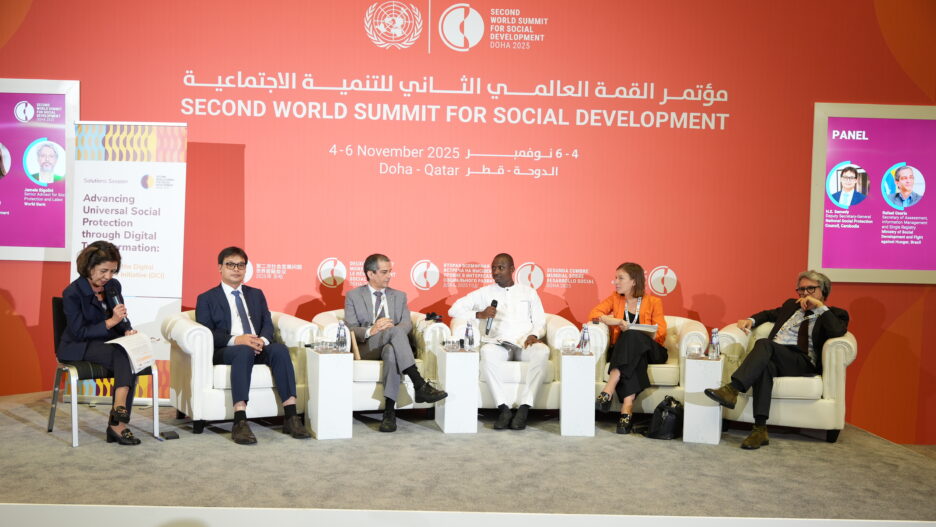
So said Shahra Razavi, Director of the Universal Social Protection Department at the International Labour Organization (ILO) and moderator of a high-level side event at the Second World Summit for Social Development (SWSSD) in Doha, Qatar in November 2025: Advancing Universal Social Protection through Digital Transformation: Insights from the Digital Convergence Initiative (DCI).
Ms Razavi’s comments introduced a unifying theme that ran throughout the presentations and discussions at this ‘solutions-focused’ meeting: the transformative power of digitalization for social protection programme design and delivery. The session showcased experience and insights to highlight how international cooperation, networks and partnerships, such as the DCI, can support the path to universal social protection and broader social development.
The session was organized jointly by the United Nations Department of Economic and Social Affairs (UN DESA), Germany’s Federal Ministry for Economic Cooperation and Development (BMZ), the ILO, and the Government of Cambodia.
Digital systems must serve the people
Charles Katoanga, Director of Inclusive Social Development at UN DESA – which played a central role in organizing and facilitating the Summit – opened the meeting by reminding the audience that ‘technology must serve the people’, particularly those at risk of being left behind. He noted that the Doha Political Declaration, adopted the previous day, explicitly recognises digital transformation as a key enabler for reaching those still excluded and for making systems more resilient, transparent and responsible.
This emphasis on people-centred systems was echoed by the keynote speaker, Professor Sabina Alkire of the University of Oxford, who drew attention to the shocking reality that some two billion people worldwide still lack sufficient – or any – social protection. Ms Alkire stressed that although definitions of social protection differ across countries, all systems need to identify poverty in all its dimensions. Without this information, digital or otherwise, governments cannot ensure that the right benefits and services can reach the people who are entitled to them. This challenge affects countries at every income level.
As part of her work at the Oxford Poverty and Human Development Initiative, Ms Alkire co-developed the Multi-dimensional Poverty Index or MPI; a flexible measure that captures deprivations in areas such as health, education, housing, and access to essential services. By connecting and integrating data from different sources, the MPI helps governments identify and address the overlapping disadvantages that shape people’s lives.
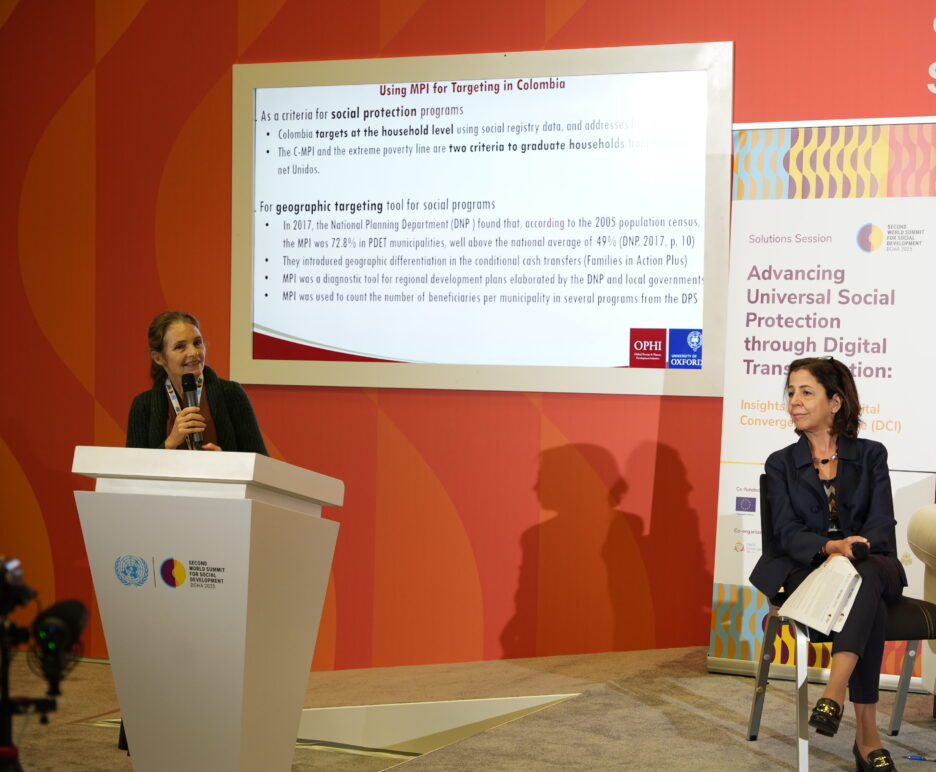
Professor Alkire illustrated this with the case of Colombia, where the government under former President Juan Manuel Santos successfully reduced multidimensional poverty by more than 35% between 2010 and 2018. Political leadership and deep engagement with social workers were crucial, as were innovations in data integration and interoperability.
During the pandemic, for example, household data were geospatially merged with health facility and vulnerability data, and later with administrative school attendance records – enabling more effective targeting and service delivery.
Country perspectives from Cambodia, Brazil and The Gambia
Cambodia, Brazil and The Gambia, and partners of the DCI, showcased different national perspectives and experiences that underline both the promise and complexities of digitalising social protection systems. H.E. Samedy Yok, Deputy Secretary General of Cambodia’s National Social Protection Council, described the persistent challenge of fragmentation: for years, different ministries and departments have operated separate information systems, resulting in inefficiencies, such as the duplication of records, as well as gaps in coverage.
The government’s new Digital Social Protection Platform (DSPP) seeks to address this by creating a single digital umbrella that provides a unified registry and gateway for eligibility checks, fraud prevention and programme delivery. However, it is not only technical interoperability that inspires Mr Yok; ‘human interoperability’ – getting people to talk to each other and collaborate across departments – is also crucial for achieving a more harmonised social protection system. Rolling out the new system to the country’s more than 1,500 communes and maintaining harmonised standards will be Cambodia’s next major challenges.
Rafael Osorio, Secretary of Assessment, Information Management and Single Registry in the Ministry of Social Development and Fight against Hunger in Brazil offered the contrasting perspective – that of a mature social protection system that is undergoing a large-scale upgrade. In early 2025, the Brazilian government replaced its long-standing single registry platform – Cadastro Único – with a redesigned, modernised system. After four years of hard work, the transition was so seamless that the shift from the old platform on a Friday to the new one on Monday went largely unnoticed by the public.
This new dynamic social registry in Brazil has greatly reduced the time needed to update beneficiary records, is aligned with national standards for digital government, and has been updated to reflect the ways in which people use the internet today. Among the benefits of the new system, built-in analytics mean that expensive IT contracts are a thing of the past, while online courses are proving a much more efficient means of training the more than 40,000 system operators. While improvements are on-going, next year will see the development of a new mobile App, timed to coincide with the 25th anniversary of the Cadastro Único platform.
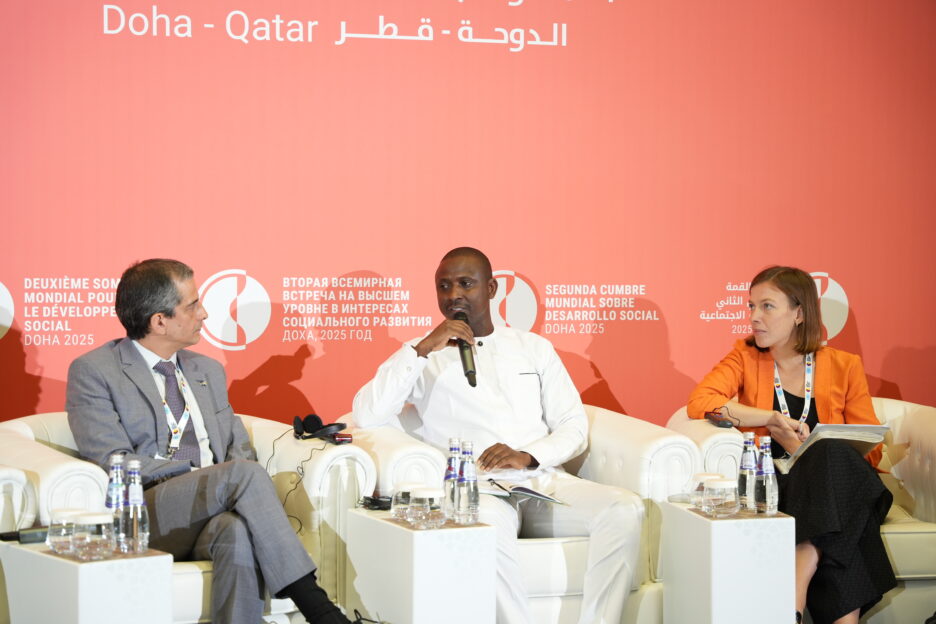
Momodou K Dibba, Executive Director of The Gambia’s National Social Protection Agency, explained how the COVID-19 pandemic revealed gaps in the country’s means to identify and reach those most in need. This prompted the creation of a new national social registry, the Gambia Social Registry or GamSR. The registry is a key tool for planning and coordination, serving as a central platform for identifying and supporting households across multiple programs, including the Nafa cash transfer and other social safety nets. The Gambia is now working with the DCI to take the next step in its digital transformation – transitioning the social registry into a dynamic platform and exploring a move toward an open-source management information system.
The global perspective: it’s all about partnerships
In answer to a question on the role of legislators and policy makers in digital transformation, Li Andersson, Chair of the Committee on Employment and Social Affairs for the European Parliament, emphasised the Parliament’s focus on regulatory and ethical safeguards, saying ‘legislators have a key role in ensuring that digital transformation is aligned with fundamental rights, non-discrimination and data protection principles.’ Robust EU-wide legal frameworks are essential, particularly as artificial intelligence becomes embedded in social protection processes, such as checking eligibility and fraud detection.
Ms Andersson also highlighted the need for portability of social protection benefits so that people can exercise their rights as they move across borders for work or study. While many EU member states operate mature national social protection systems, achieving interoperability between them remains a huge challenge.
Overcoming these challenges requires collaboration and partnership; a key theme taken up by Jamele Rigolini, Senior Advisor for Social Protection and Labor at the World Bank, speaking on behalf of the DCI. He underscored the network’s important role in developing global interoperability standards, sharing knowledge and best practices, and building digital capacities – all of which are essential for supporting countries to develop or implement their own digital technologies responsibly and safely.
Pointing to the scale of the work ahead, he referred to what he calls the ‘rule of halves’: only half of countries with national registries have dynamic ones, and only half of countries with payment systems have digital payments. ‘We need to join forces to ensure the rapid progress that is urgently needed,’ he said, urging more countries to join the DCI partnership.
A shared agenda for the future
The session closed with reflections from Erica Gerretsen, Director of DG INTPA, Directorate G (Human Development, Migration, Governance and Peace), at the European Commission, which is a key funder of the DCI. She reminded participants of the fragility of the world we live in, where climate change, technological disruption and widening inequalities – among other things – demand more coordinated responses. Social protection, she noted, lies at the heart of the EU’s social market economy, underpinning prosperity and trust in institutions.
She echoed the call for more countries to seek support through the DCI, highlighting the network’s vital contributions to the global social protection agenda. The experiences shared by Cambodia, Brazil and The Gambia, Ms Gerretsen said, demonstrate that systems can and must be adapted to national priorities and people’s needs:
With the DCI we can do this. I want to emphasise the call for more countries to come to the DCI for support. There is no time to lose in advancing this agenda together with our partner countries. No one can do this alone.
Author: Corinne Grainger