Digital readiness for cross-border portability of social security benefits in CARICOM
Overview:
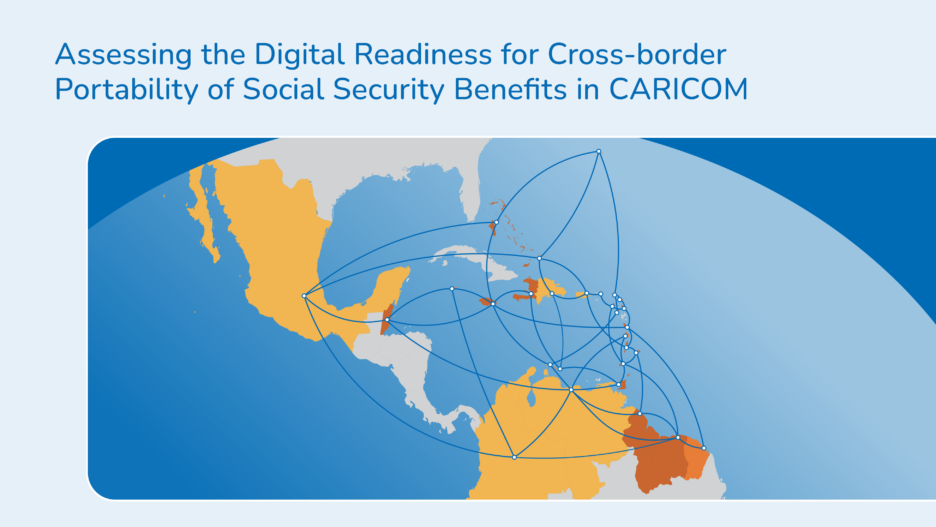
Our latest publication offers an in-depth assessment of digital readiness for social security administration and the cross-border portability of benefits across the Caribbean Community (CARICOM). The report was jointly prepared by the International Labour Organization (ILO), International Social Security Association (ISSA) and the United Nations University Operating Unit on Policy-Driven Electronic Governance (UNU-EGOV) under the Digital Convergence Initiative.
The challenge of making social security portable in a region like CARICOM is shaped not only by legal and institutional fragmentation, but also by the structural realities of small jurisdictions. By analysing the legal, administrative, technical, data and cross-border exchange-related barriers, this assessment provides valuable insights into the region’s digital readiness, identifies key gaps and opportunities for improvement and offers an evidence base for strengthening both domestic and cross-border coordination of social security entitlements.
Key findings:
While CARICOM has established important legal, institutional and digital foundations for cross-border social security portability, significant implementation gaps remain. Key findings include:
- Legal and regulatory frameworks: While the CARICOM Reciprocal Agreement on Social Security provides a regional legal foundation for benefit portability, implementation remains fragmented due to differences in national regulations, limited formalised data-sharing arrangements and the absence of harmonised procedures for processing cross-border claims.
- Administrative processes: Benefit portability processes remain largely manual and fragmented across institutions, resulting in delays and operational inefficiencies. Despite the availability of digital administrative systems, end-to-end workflows for cross-border claims processing, verification and case management remain underdeveloped.
- Institutional and technical capacities: Significant variations in institutional capacity, digital maturity and technical infrastructure across the region continue to constrain effective cross-border coordination and secure data exchange.
- Data management and interoperability: Although some participating institutions have established a strong foundation of digital records and operational information systems, important gaps remain in interoperability, data standardisation, unique identifiers and common technical standards for secure cross-border information exchange.
- Demand for cross-border services: Demand for portability-related services is evident, particularly for cross-border claims coordination. However, existing administrative and data exchange arrangements lack the operational capacity to respond efficiently and consistently to these needs.
Overall, the report highlights the need for a coordinated, phased approach to strengthening regional interoperability, building on existing digital assets and prioritising practical improvements in areas such as claims coordination, proof-of-life verification and contribution history exchange.
Share your thoughts
Enjoyed this piece? We would love to know what you think. Your feedback helps us make our work better.