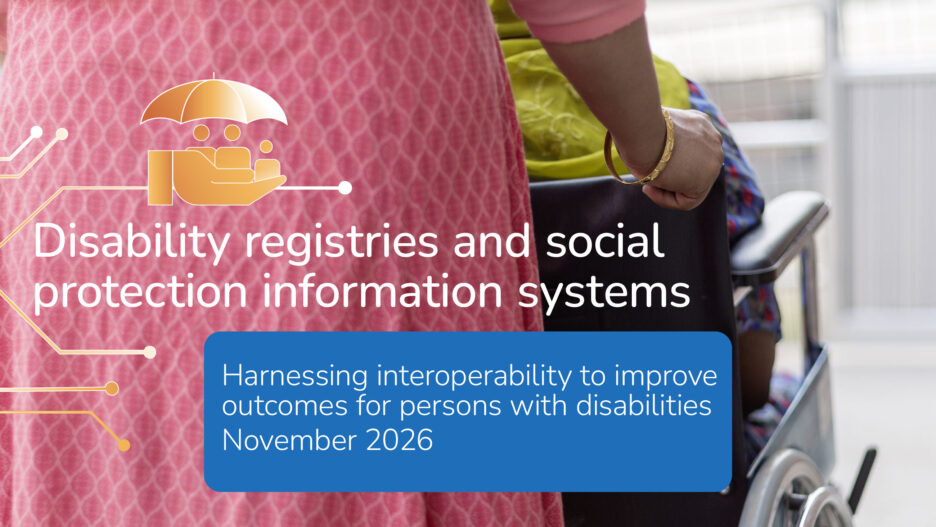
Harnessing interoperability to improve outcomes for persons with disabilities
Overview
Persons with disabilities represent approximately 16% of the world’s population – over 1.3 billion people – and are disproportionately represented among the poorest and most marginalised groups (WHO, 2022). They face higher barriers to educational attainment and employment, and significantly higher costs of living due to additional expenditure on care, assistive technologies, and health services. These ‘costs of disability’ compound across the lifecycle. These inequities intensify during crises: without deliberate inclusion, persons with disabilities are consistently among the last to be reached in emergency expansions of assistance.
Why this publication matters:
This paper supports practitioners and policymakers in understanding and advancing interoperability between disability registries and social protection information systems, drawing on country experiences to examine the complementarities between the two systems, the conditions under which data exchange generates meaningful improvements, and the risks that need to be managed along the way. It is intended as a non-technical companion to the Digital Convergence Initiative’s (DCI) interoperability standards, bringing the case for interoperability to life through country examples. It is intended as a resource for governments, development partners, and organisations of persons with disabilities – whether they are designing a disability registry for the first time or seeking to deepen linkages between systems that already exist.
Required citation:
Digital Convergence Initiative. 2026. Disability Registries and Social Protection Information Systems. Deutsche Gesellschaft für Internationale Zusammenarbeit, Germany.
Share your thoughts
Enjoyed this piece? We would love to know what you think. Your feedback helps us make our work better.