Why data governance matters for digital social protection

Amina woke before sunrise and set out for the small market center in northern Kenya. She had received a SMS that her drought relief payment was ready. She carried her id card and the hope that she would bring home enough money for food. At the payment point she stood in a long line under the heat. When she reached the counter, the agent checked his device and told her that her name was not on the list.
Later she learned that her surname appeared one way in the social registry and another way in the payments file. A small inconsistency in a digital system became a heavy blow in her day. She walked home without the support she depended on, unsure when the mistake would be fixed.
Stories like this show why careful data work is not a technical detail but a lifeline.
Around the world, countries are moving fast to build digital tools for social protection. They are creating social registries, electronic payments, shared databases, and linked information systems. These tools help programs run faster and reach people during times of crisis. Yet as systems grow more connected, the need for clear rules and strong data practice grows as well. Without that, tools that aim to widen access can instead close doors for people like Amina.
Digitalization without governance risks leaving people behind
Digital social protection systems rely on continuous data flows such as registration records, eligibility checks, ID verification, payment instructions, grievance redressal mechanisms. As countries increasingly rely on digital tools, weak governance can manifest in several harmful ways:
1. Exclusion through data errors
Minor inconsistencies, outdated household information, or mismatched IDs can lead to wrongful exclusion from benefits, especially for people with low literacy, remote access, or complex family structures.
2. Fragmentation across multiple systems
Digitized social registries, payments, case management platforms, and ID databases still need shared standards and rules to “talk” to one another. Without this, interoperability becomes difficult, leading to delays and inaccuracies.
3. Privacy and security vulnerabilities
Digital systems store highly sensitive data, from biometric identifiers to household socio-economic information. Weak data protection exposes beneficiaries to risks such as unauthorized access, data misuse, or identity theft.
4. Reduced effectiveness in crises
When floods, droughts, or pandemics strike, governments must quickly identify affected households. Disorganized or inconsistent data hampers rapid response efforts.
5. Confusion over responsibilities
Without clear governance structures, it becomes unclear who is responsible for correcting errors, updating records, handling grievances, or maintaining databases, prolonging problems for beneficiaries.
These challenges are not hypothetical. They are recurring realities in countries at all income levels, and they disproportionately affect the people social protection systems exist to serve.
Data systems need more than technology, they need governance
As digitalization accelerates, countries risk investing heavily in technology while overlooking the institutional arrangements, standards, and processes needed to manage data ethically and effectively (DCI 2023). Good data governance ensures that digital tools serve people, not the other way around.
Imagine a different scenario for Amina:
She updates her mobile number once at a community office. The information is validated, synchronized securely across the social registry, payment system, and program database, and instantly reflected in the next payment cycle. If something goes wrong, clear roles and audit trails make it easy to identify and fix the issue.
This vision is achievable, but only with strong data governance in social protection systems.
Build first or govern by design? The hidden cost of delayed data governance
As countries—particularly in developing and emerging economy contexts—accelerate the digital transformation of social protection, they face a critical but often under-acknowledged choice. One path prioritizes speed through a “build first, protect later” approach, rapidly rolling out registries, payment platforms, and system integrations while deferring data governance, privacy, and accountability. The alternative is a “governance and protection by design” approach, where data governance, security, and institutional guardrails are embedded from the outset as core system requirements rather than retrofitted add-ons.
In practice, many countries gravitate toward the first option due to crisis pressures and delivery timelines. While this can yield short-term gains, it creates long-term risks: fragmented standards, technical debt, vendor lock-in, and weak accountability that become increasingly costly to fix as systems mature. Retrofitting governance later often requires expensive redesigns and policy changes and can undermine public trust. By contrast, embedding governance early is significantly inexpensive, enables sustainable scaling and shock responsiveness, and ensures alignment with broader national data and digital policies—making it not just a technical decision, but a strategic one with lasting social and fiscal implications.
Introducing DCI’s new publication: A data governance framework for digital social protection systems
Data is abundant in social protection—but too often it’s fragmented, inaccessible, or disconnected. Watch our data governance webinar to discover DCI’s new framework and real-world examples from Chile and Türkiye.
To support countries navigating this transition, the Digital Convergence Initiative (DCI) has developed a comprehensive Data Governance Framework for social protection systems (DCI 2025). It provides practical guidance to ensure that digital systems are built on a foundation of accuracy, accessibility, security, and accountability.
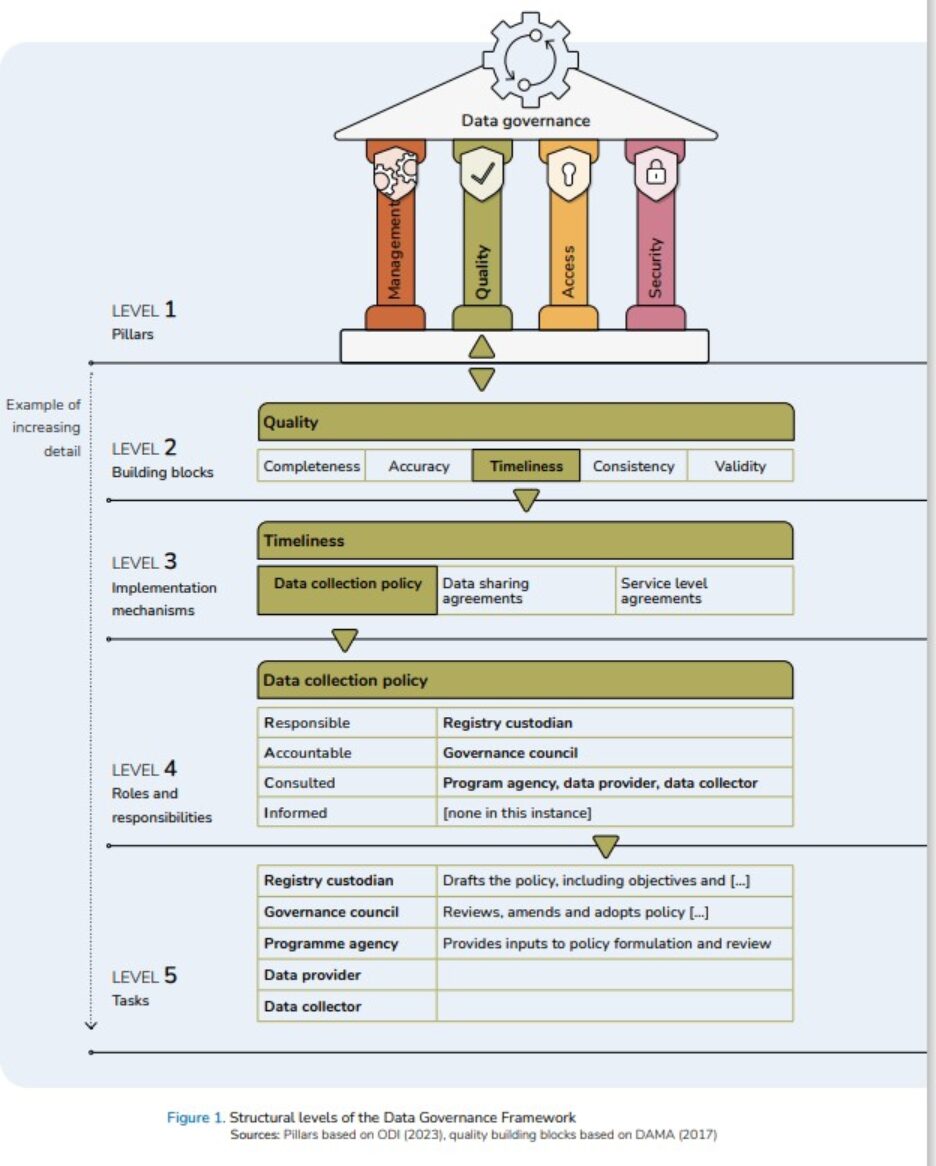
The Framework is structured into five levels (figure 1), moving from overarching concepts to tangible action:
Five levels of the Data Governance Framework
- Level 1: Pillars of Data Governance: The Framework is built on four foundational pillars—management, quality, access, and security—that together offer a comprehensive view of data governance in social protection.
- Level 2: Building Blocks: Each pillar is broken into specific building blocks. For example, the data quality pillar includes completeness, accuracy, timeliness, consistency, and validity.
- Level 3: Implementation Mechanisms: For each building block, the Framework outlines concrete mechanisms. For example, ensuring data timeliness may involve data acquisition policies, data-sharing agreements, and service-level agreements.
- Level 4: Roles and Responsibilities: The Framework assigns tasks to the relevant actors. For instance, drafting an acquisition policy for household interviews would be led by the social registry, overseen by the data governance council, and informed by data collectors and program administrators.
- Level 5: Actions and Task Assignment: The final level breaks down the operational tasks needed to put those mechanisms into practice, identifying which institution must act and how.
Figure 1: Structural levels of the Data Governance Framework
Click here to view in the document.
Importantly, DCI’s Data Governance Framework is not intended as a rigid blueprint. Rather, it serves as a starting point to structure and initiate country-level dialogue on data governance in social protection. Context matters deeply—countries differ in legal frameworks, institutional mandates, levels of digital maturity, and political economy constraints. There is no one-size-fits-all approach. Effective data governance arrangements must therefore be adapted, sequenced, and prioritized based on national realities. Crucially, governance of social protection data should not evolve in isolation. It needs to be aligned with broader national data governance, digital government, and personal data protection policies to avoid fragmentation, duplication, or conflicting mandates. Making these linkages explicit—and debating trade-offs openly—should be a core part of the reform process, rather than an afterthought.
Putting people at the center of digitalization
Digitalization without governance risks reinforcing the very vulnerabilities social protection aims to address. When data is poorly managed, people are excluded. When it is insecure, people are exposed. When responsibilities are unclear, problems persist.
Robust data governance flips this dynamic. It ensures digital systems are reliable, ethical, interoperable, and transparent. It protects beneficiaries’ rights, strengthens public trust, and ultimately allows social protection systems to function as intended, providing security, dignity, and resilience to those who need it most.
As countries continue to digitalize social protection systems, the question is no longer whether data governance matters. It is how quickly and comprehensively governments can put it in place.
Authors: Sarang Chaudhary and Anna Deniz.