Lessons from EU, MERCOSUR, and ASEAN: Making social security portable across borders
In an increasingly mobile world, social protection systems are struggling to keep pace with human mobility. More than 300 million people now live outside their country of birth, many contributing to pension, health insurance, unemployment, and social insurance systems across multiple countries during their working lives (United Nations, 2025). Yet for millions of migrant workers, those contributions do not seamlessly translate into accessible entitlements when they move across borders.
This challenge — known as the cross-border portability of social security entitlements — is becoming one of the defining policy questions of global labour mobility. At its core, cross-border portability refers to the ability of migrants to preserve, maintain, and transfer social security rights accumulated across different countries over the course of their life (Holzmann et al., 2005).
Without portability, migrant workers risk losing years of contributions, facing fragmented pension records, or being excluded from healthcare and unemployment protections. This creates not only social injustice, but also labour market inefficiencies and disincentives for formal employment.
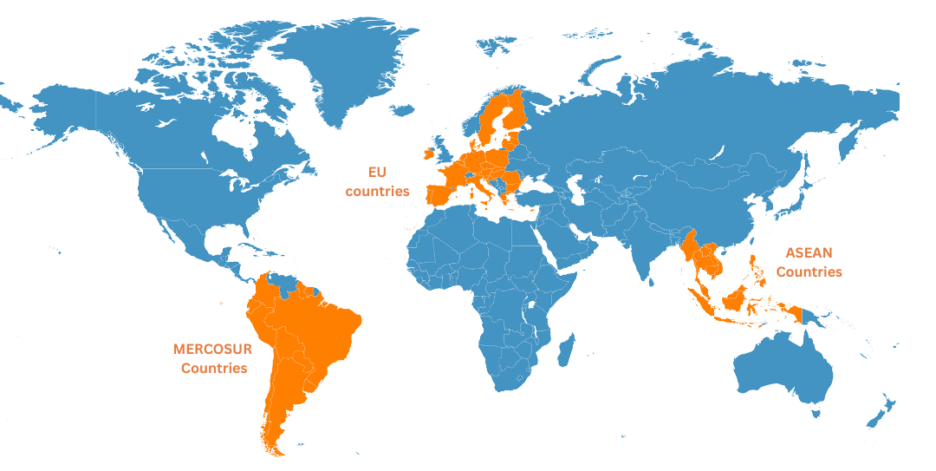
A new exploratory research report by the Digital Convergence Initiative (DCI) examines how different regions are approaching this issue, focusing on experiences from the European Union (EU), MERCOSUR (Southern Common Market) in South America, and ASEAN (Association for Southeast Asian Nations). The findings reveal both the promise and complexity of building interoperable, cross-border social protection systems.
Why portability matters
Modern migration patterns are increasingly regional. In Europe, workers move freely across EU member states. In Southeast Asia, millions migrate between countries such as the Philippines, Thailand, Malaysia, and Singapore for work. In Latin America, labour mobility within MERCOSUR countries continues to grow, while the Venezuelan displacement crisis has accelerated regional migration flows. Similarly, across the Africa region, conflict, climate change, food insecurity, and demographic pressures are contributing to rising levels of migration and displacement.
Yet social security systems remain overwhelmingly national in design. A worker may contribute to pension systems in Argentina, Germany, Kenya, Rwanda, and the United States during their lifetime, but accessing those accumulated rights can require navigating disconnected institutions, incompatible databases, and differing eligibility rules.
The report highlights several interconnected political, legal, organisational, semantic, and technical barriers:
- Political concerns around sovereignty and fiscal implications slow harmonisation of portability measures.
- Fragmented legal frameworks, reliance on bilateral agreements, and differing eligibility rules create benefit gaps for migrant workers.
- Organisational barriers arise when institutions work in isolation and limited administrative capacity makes cross-border coordination difficult.
- Semantic barriers arise from inconsistent definitions, classifications, languages, and incomplete registries, reducing interoperability.
- Technical bottlenecks include legacy systems, weak interoperability, and limited real-time data exchange.
The European Union
Among all regions examined, the European Union represents the most mature system for cross-border social security coordination. The EU framework is built on legally binding regulations that guarantee four core principles:
- Coverage under only one social security system at a time
- Equal treatment between nationals and migrant workers
- Aggregation (’totalisation(1)’) of contribution periods across countries
- Exportability of cash entitlements such as pensions across borders
What distinguishes the EU is not only its legal architecture, but also its investment in digital interoperability.
A flagship innovation is the Electronic Exchange of Social Security Information (EESSI), a digital platform connecting more than 3,400 institutions across 32 countries. EESSI enables secure, standardised, real-time electronic exchange of social security information related to pensions, unemployment benefits, maternity benefits, occupational injuries, and other entitlements. Instead of relying on slow paper-based communication between countries, EESSI allows institutions to exchange verified contribution histories electronically. This dramatically reduces processing delays, administrative errors, and duplication.
The EU is also experimenting with future-oriented innovations such as:
- European Digital Identity Wallets (EUDI eWallets)
- Blockchain-enabled verification systems
- The European Pension Tracking Service (ETS), which allows individuals to view pension rights accumulated across multiple countries in one interface
Still, Europe faces substantial challenges. Legacy systems, uneven digitalisation across member states, language differences, and the absence of a unified beneficiary registry continue to create friction. The EU experience nevertheless demonstrates a critical lesson: portability works best when legal coordination, institutional governance, and digital infrastructure evolve together.
MERCOSUR: strong political foundations, a big opportunity to leverage digitalisation
MERCOSUR offers a contrasting example. The South American bloc has established a legally binding Multilateral Social Security Agreement that coordinates pension rights among member states including Argentina, Brazil, Paraguay, and Uruguay.
The region has also benefited from broader migration and integration frameworks that facilitate labour mobility.
Yet despite these political and legal advances, implementation remains uneven. The DCI report notes that portability processes in MERCOSUR often lack:
- Standardised data exchange systems
- Shared digital registries
- Common interoperability standards
This gap between political commitment and operational capability is one of the report’s most important findings. Legal agreements alone are insufficient if institutions cannot exchange reliable data securely and efficiently.
At the same time, MERCOSUR also offers promising examples of regional cooperation. Initiatives such as the MERCOSUR Digital Citizen and Red de Gobierno Electrónico de América Latina y el Caribe (GEALC) are helping strengthen digital government collaboration and interoperability across Latin America.
The lesson from MERCOSUR is that regional political alignment creates a foundation for portability, but sustained investments in digital public infrastructure are necessary to operationalise those ambitions.
ASEAN: early-stage
ASEAN represents the earliest stage of portability development among the three regions studied. Unlike the EU and MERCOSUR, ASEAN does not yet have a binding regional social security agreement.
Instead, portability arrangements are largely managed through bilateral agreements between individual countries, often covering only limited benefit categories such as pensions or work injury compensation.
ASEAN’s approach has been incremental and consensus based. The region adopted non-binding Portability Guidelines in 2018 and the 2022 ASEAN Declaration on Portability of Social Security Entitlements for Migrant Workers.
Pilot collaborations — particularly between Thailand and the Philippines — illustrate attempts to build trust and institutional cooperation gradually.
The ASEAN case reflects the realities of highly diverse labour markets, varying institutional capacities, and large informal economies. Many migrant workers in Southeast Asia are short-term or circular migrants who often fail to accumulate enough contributions to qualify for formal benefits. This raises a broader policy challenge: portability systems designed for long-term formal employment may not adequately serve the realities of contemporary migration patterns.
What needs to happen next?
The report argues that there is no universal portability model. Countries pursue different objectives, have different migration patterns, and operate under different institutional capacities.
Still, several overarching recommendations emerge across regions.
- Modernise legal frameworks
Countries need updated bilateral and multilateral agreements that clearly define rules for:
- Aggregation of contribution periods
- Exportability of benefits
- Equal treatment of migrant workers
- Administrative cooperation
2. Invest in interoperable digital infrastructure
Digitalisation is not a silver bullet, but interoperable systems are essential for operational portability. Governments should invest in:
- Digital identity and payment systems
- Shared data standards
- Secure APIs for data exchange
- Integrated social registries
- Cross-border authentication mechanisms
3. Strengthen institutional coordination
Portability depends heavily on trust and coordination between institutions. Regional coordination bodies, technical working groups, and long-term cooperation mechanisms are essential.
4. Prioritise data governance and protection
Cross-border data exchange requires strong legal safeguards, cybersecurity standards, and privacy protections. The EU’s GDPR framework offers one example of how trusted data-sharing ecosystems can be built.
5. Design for inclusion
Current portability systems tend to privilege formal, long-term workers. Policymakers must consider how portability can also work for:
- Informal workers
- Seasonal migrants
- Circular migrants
- Refugees and displaced populations
Author: Sarang Chaudhary
Footnotes
(1) A mechanism by which contribution periods in different systems are added together to meet eligibility criteria for entitlements. This is critical for workers who move across borders or between schemes (Holzmann et al., 2005)