Early warning meets social protection: a new DCI interoperability standard
A drought warning needs to reach those who have the ability to act on it. DCI’s new Early Warning Systems interoperability standard provides a solution for that.
Families pay the cost of gaps in the system
Picture a district heading into a dry season. In one ministry, forecasters can see that there will be little to no rainfall. In another ministry, the social protection team holds a registry of the farming households who will be adversely affected, plus have a payment system that can be used to reach them. Each has a crucial part of the big picture – but they are rarely combined.
For the families in that district, the gap is costly. When the rain fails, they sell livestock, borrow at high interest or take children out of school, and those losses are hard to recover from. In one example looking across countries, a joint FAO, WFP and OCHA review found that each dollar spent on anticipatory action returns up to seven dollars in avoided losses and added benefits (PreventionWeb).
Where the link breaks
Hazards rarely impact just one aspect of daily living. A flood that washes out a road also cuts families off from markets, clinics and schools. A failed harvest turns into lost income, and for a household already close to the edge, lost income can tip them into long-term poverty. Yet, the systems that can predict these shocks, and the systems that can support households to weather the storm usually function separately.
The responsibility for early warning tends to be with meteorological and disaster management agencies, and social protection with a separate ministry – each with its own data and software. When information is exchanged between them, it often travels by email or spreadsheet, prepared from scratch each time. That can carry a pilot, but cannot carry a national system dealing with numerous urgent alerts annually, across several hazards.
How DCI’s standard works
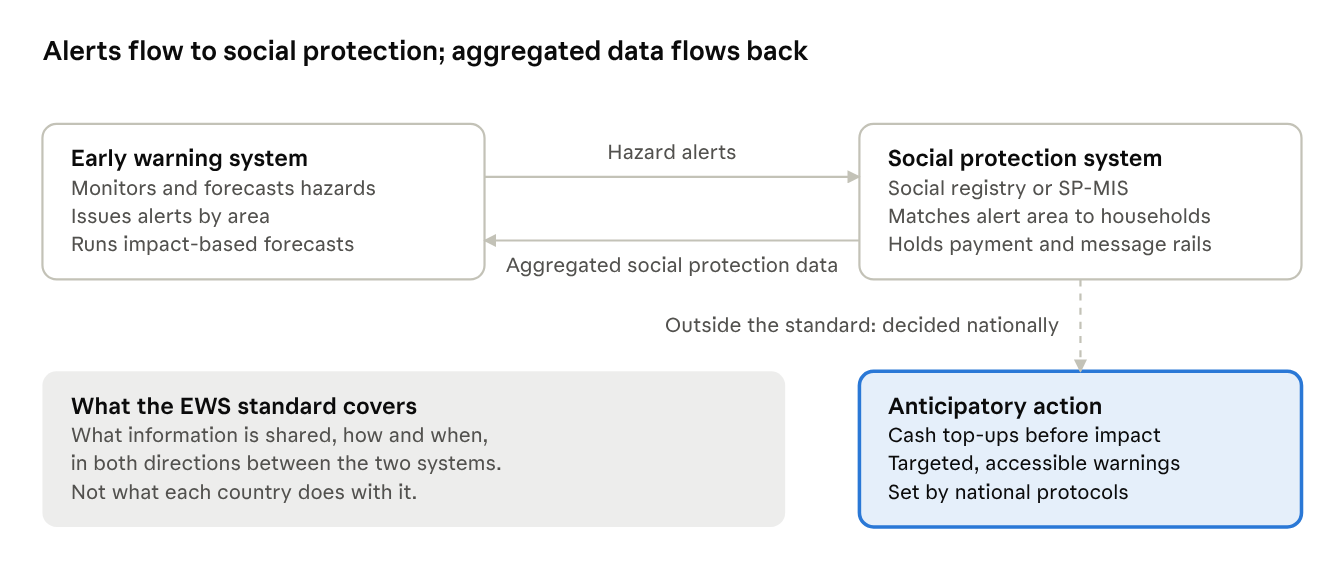
DCI’s Early Warning Systems (EWS) interoperability standard gives both sides a common way to exchange information: what is shared, and how, in a format each system can read and interpret in the same way. It covers two processes:
- One process runs from early warning to social protection. An alert describes the hazard, how severe it is, when it is expected and which areas it will affect. Because those areas can be matched to the districts the social protection registry already uses, the social protection team can see which registered households are likely to be in its path.
- The other runs back. Social protection systems can share aggregated figures, such as how many poor households, older people, young children or persons with disabilities live in each district, without any personal records leaving the ministry. Forecasters and disaster managers can then gauge both where a hazard will strike and who will be affected.
The standard stops at the exchange of information. Whether an alert leads to a top-up, an emergency enrolment, a warning message, or nothing at all, is decided by each country and institution, under its own mandate and protocols.
One interface among several
Matching an alert to a household also depends on records held elsewhere within the government. The EWS standard is part of a wider set of DCI standards, each covering the exchange between a social protection system and one other system. Civil registration systems keeps records current as children are born and people die. ID systems confirm the identity of the person receiving support. Social registries and integrated beneficiary registries hold information on the households and the programmes they are enrolled in. Farmer and disability registries include who depends on the harvest and who may need a different kind of support.
Built on internationally established standards, these connections are made once and reused, rather than rebuilt for every emergency or negotiated pair by pair. Households are counted once, records stay consistent and fewer people are overlooked. DCI’s learning brief notes that connected systems can bring assistance within days rather than months.
Decision-making remains with governments
A standard makes the exchange possible, but it does not make the decisions. Support still reaches only the households that are in the registry, and only where financing and decision rules have been agreed upon before the shock. Those remain policy choices for each country.
The best time for forecasters, disaster managers and social protection teams to agree how they will share information is in a quiet season, not in the middle of an emergency. For governments planning that step, the DCI Helpdesk offers targeted advice on applying DCI standards, including the EWS standard.
Author: Aisha El-Merhebi