From Knowledge to Action: Understanding the AI Hub publications
Why is there a need for new sector-specific knowledge products?
The challenge of using artificial intelligence (AI) in social protection is not only to keep up with new technologies, but understanding the implications of AI use in social protection. To understand what has been done already by other countries, to be aware of risks and how to address them, to understand sovereignty implications, and before all of that, to be familiar with key AI terminologies and how they ‘fit’ in our sector. Ultimately, it is about understanding how AI changes processes, decision making and accountability in social protection institutions, ultimately affecting the people we aim to serve.
For policymakers and practitioners, this means knowing where to start, what evidence to trust, which questions to ask, and how to move from ideas to responsible action. It means being immersed in the global dialogue, because knowledge sharing is key to moving forward. This is where the Digital Convergence Initiative AI Hub’s knowledge products come in.
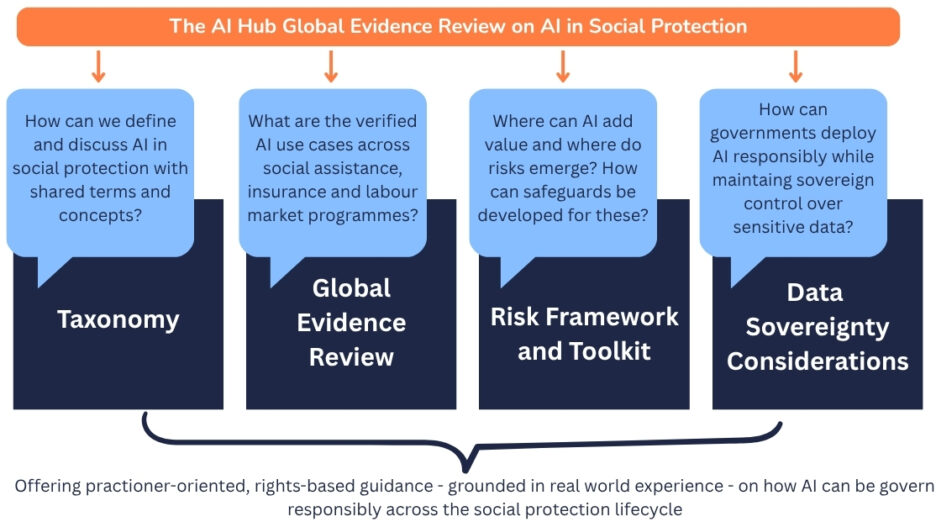
The AI Hub has developed a connected portfolio of four publications (complemented by technical support if needed) designed around the user journey of a social protection practitioner who is deepening their understanding of this topic. Each publication answers a different question, helping users move from understanding AI to assessing its relevance, navigating its risks, and considering how it can be applied in their own context.
The first step: establishing a shared language
The user journey begins by making sure all users understand a common vocabulary of AI in social protection. A Taxonomy for AI in Social Protection: Defining capabilities and application areas provides that starting point.
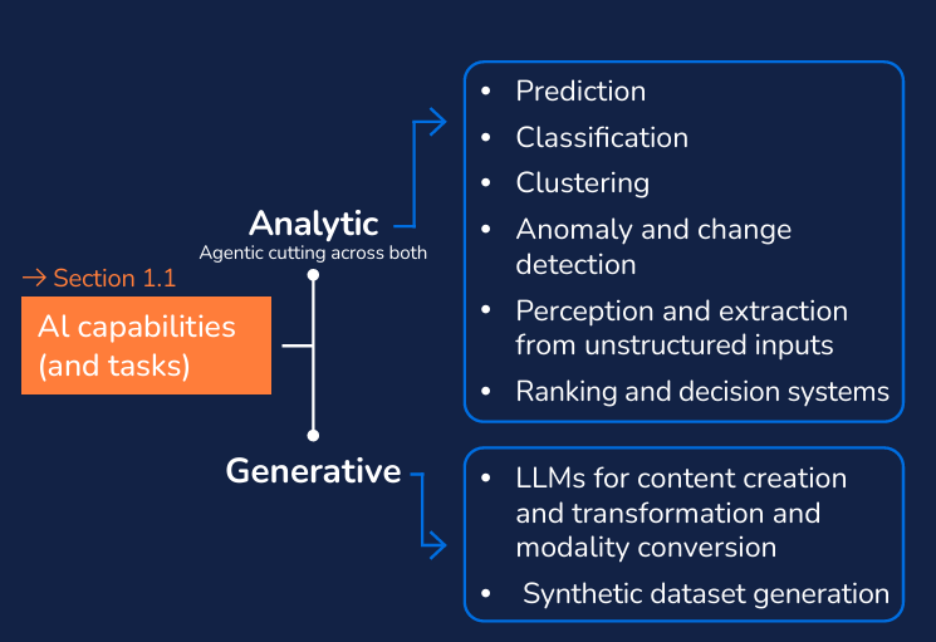
By defining key AI capabilities and mapping them to application areas within social protection (‘use cases’), the Taxonomy establishes a common vocabulary for policymakers, researchers, practitioners, and developers. It helps users make sense of an increasingly complex field and provides a foundation for placing different applications in discussion. It also helps to showcase the realm of what is possible, not just the use cases that are already typically being pursued by governments (often those that focus on efficiency gains rather than enhanced support for people and households). It is important to acknowledge that AI, and especially using AI in social protection, is a fast-moving field, with new developments, evidence, and applications emerging continuously. This is a living publication reflecting the best available information at the time of publication and will continue to evolve along with the field.
The AI landscape is swiftly changing and the Taxonomy will have to change with it. It is a version 1 of a conversation that will continue to unfold with stakeholders, which is why feedback and engagement from readers are highly recommended. The fruitful conversations that the AI Hub team has had with the World Bank, ISSA and OECD have been highly beneficial to this Taxonomy and portfolio at large.
The second step: understanding the landscape
The next stop on the user journey is connecting with global practices. The AI Hub’s aim with the publications is to create a platform for sharing knowledge, experiences and lessons learned. To do that, its important to first know what is actually being done, where and by whom? What is working, what is not and why?
AI Adoption in Social Protection: A Global Evidence Review (2020–2025) helps answer this question by bringing together evidence from more than 90 countries and documenting verified AI use cases across social assistance, social insurance, and labour market programmes. It provides a starting point for understanding emerging trends, applications, and lessons from real-world experience.
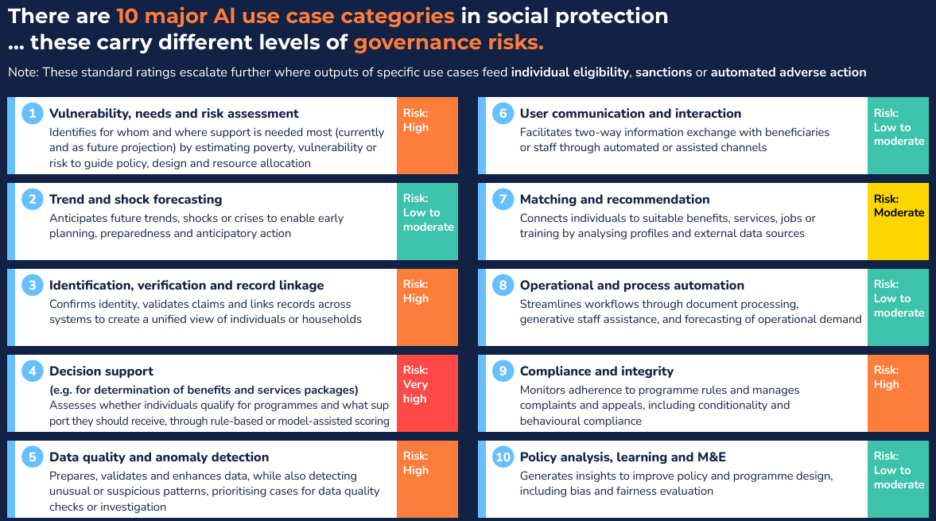
Together, the Taxonomy and Global Evidence Review help users move from foundational questions like ‘What is AI?’ to application questions, like ‘What can be learnt from each use case? How can we build on previous applications while learning from others’ mistakes?’
The third step: responsible AI application
The next stage addresses more difficult – yet fundamental – questions about using AI in social protection systems. What rises from this stage in the user journey is the users’ recognition of their agency, and ethical responsibility.
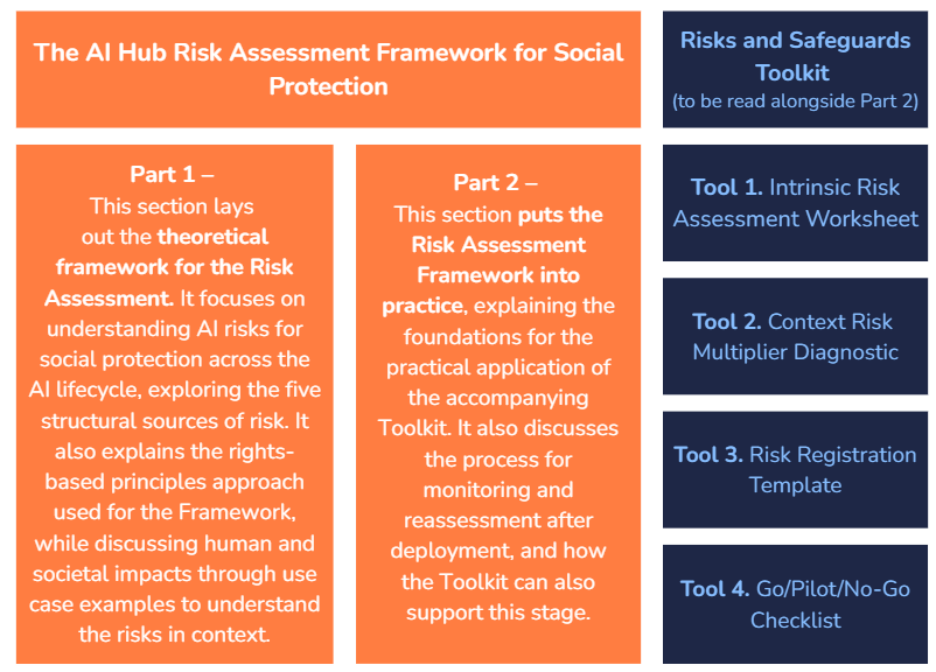
Building on lessons learned from past use cases, and research about the risks associated with AI tools, the AI Hub Risk Assessment Framework for Social Protection was published as a foundational guide for practitioners. Structured into different sections some of which are conceptual, others analytical, and concluding with a that is easy to apply, this publication is an invaluable tool for everyone navigating this sector.
- The framing document takes users on a conceptual journey that starts at “what are the different kinds of risks AI introduces to the sector?”, moving to “what do risks look like across the delivery chain?” and “How can we conduct thorough risk assessments?”, including the importance of “monitoring and reassessment (post implementation).”
- Most importantly, the Framework is accompanied by 4 Tools that act as ready to use templates for users (how to use these is explained in depth in Part 2 of the framing document): the Intrinsic Risk Assessment, Context Risk Multiplier Diagnostic, Risk Register, and Go/No-Go Checklist (all available as Word documents for ease of use!).
Through this publication, the AI Hub lays the groundwork for guided AI application that is proactive and responsible.
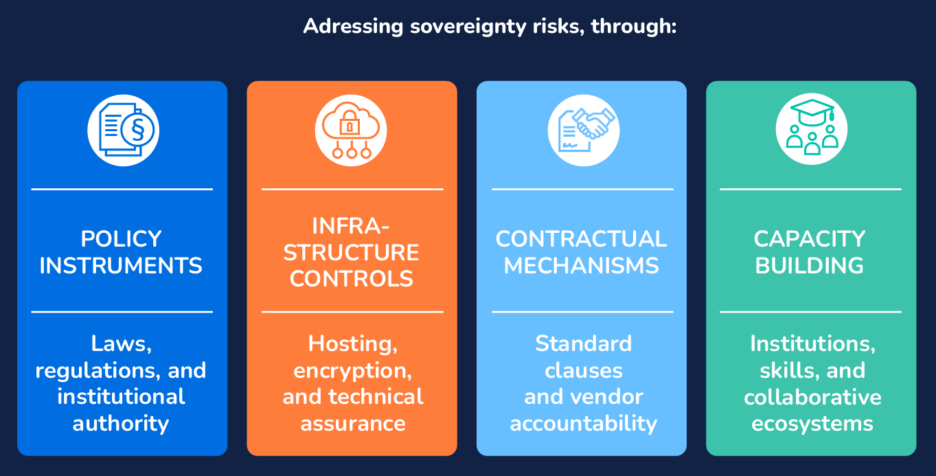
An equally important step when applying AI in social protection is understanding data sensitivity and mitigating sovereignty risk. In AI for Social Protection: Data Sovereignty Considerations, users are encouraged to explore questions around data, protection, and digital sovereignty, helping institutions consider not only what AI can do, but also the implications of how data and technology are managed. The primary purpose of this publication is to take users to the step of “this is how AI can be considered ethically and responsibly in our context, enhancing sovereignty over our citizens’ data.” In doing so, it emphasises the responsibility of governments to protect that data and acknowledges existing challenges to integrate AI tools in a context where AI systems are hegemonised by a select number of multinational companies.
With this, users are encouraged to consider questions of power and data protection at every stage of the AI lifecycle, aligned with broader DCI-endorsed guidance on Data Protection for Social Protection.
To sum it all up: a living knowledge ecosystem
The AI Hub’s flagship knowledge product architecture is ultimately about more than organising publications. It is about making knowledge useful, connected, and actionable. The user journey does not end with reading the AI Hub’s publications.
As evidence, technologies, and country experiences evolve, the portfolio will evolve with them. The aim is to give social protection institutions a trusted pathway through an increasingly complex AI landscape — helping them ask better questions, make informed choices, and adopt AI in ways that are responsible, innovative, and sovereign.
The journey is not necessarily linear. A user may begin with a specific use case, return to the Taxonomy to clarify terminology, consult the Global Evidence Review for comparable examples, or turn to the Risk Assessment Framework before implementing a new tool. Each knowledge product is therefore designed to stand on its own while also connecting to the wider ecosystem.
Joining the global dialogue means engaging with the publications, but also engaging with key challenges and opportunities grounded in real life applications. The AI Hub’s Clinic Series is designed to foster peer-to-peer dialogue and experience-sharing across experts and institutions. From assessing institutional and data readiness, through ethics and governance, to identifying and scoping concrete use cases.
Next to this, the AI Hub is developing standards, guidelines and Digital Public Goods (DPGs) to support the responsible implementation of AI. The AI Hub’s Help Desk also provides free of charge advisory services to countries deploying AI for social protection through support with strategy, governance and technical development. Read more here.
In doing so, the AI Hub for Social Protection is creating a pathway for continued dialogue and support, moving from discovery to understanding, from understanding to assessment, and from assessment to action.
Author: Nour Barakat